‘No Comment’ Is Never a Strategy
Silence Does More Damage Than the Story Itself
For decades, public officials, corporations, attorneys and executives have relied on a familiar phrase when facing difficult questions:
“No comment.”
The assumption has always been that silence is neutral.
It isn’t. It never was!
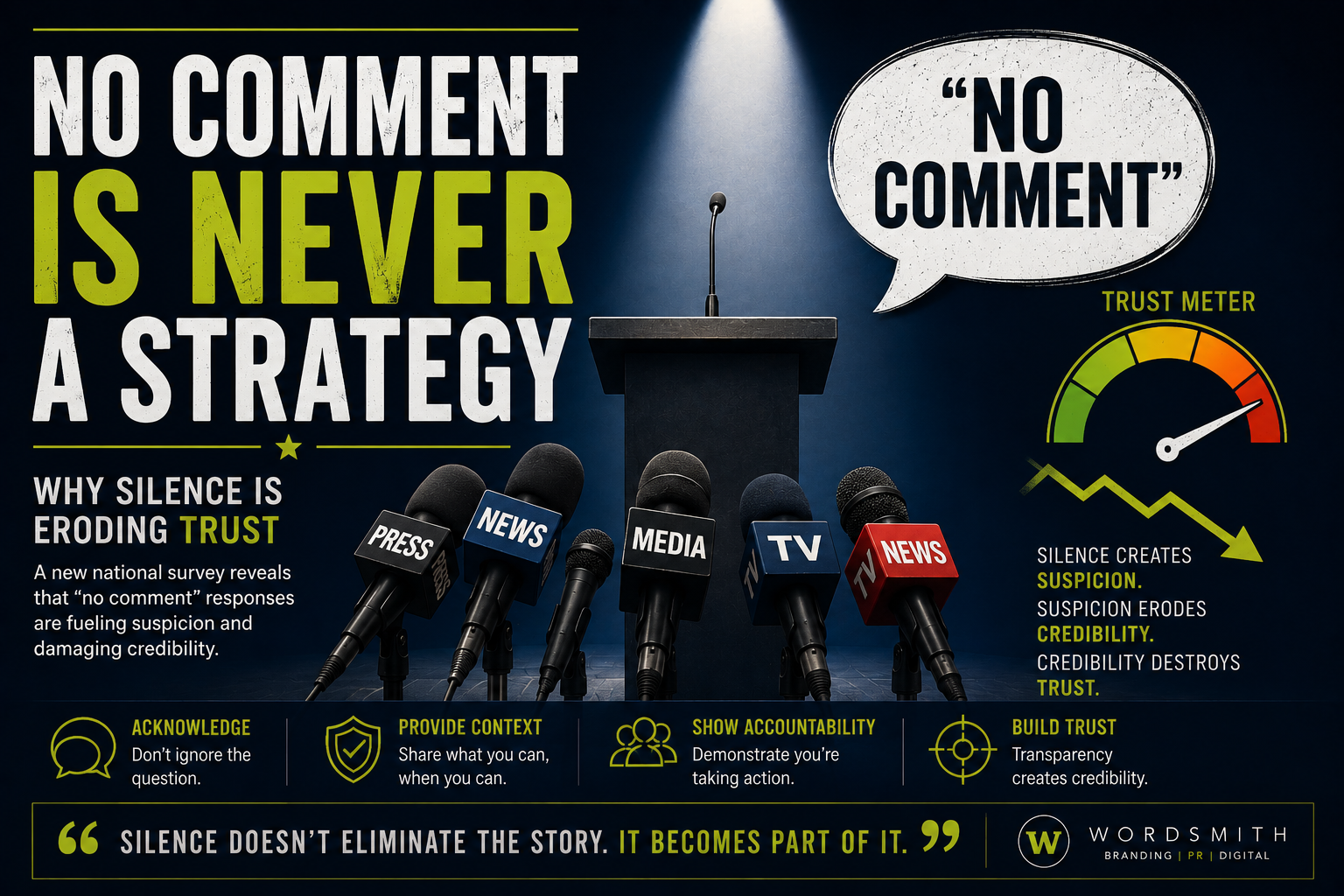
According to new research from the Reynolds Journalism Institute and SmithGeiger, audiences no longer view “no comment” as a harmless response. Increasingly, they interpret it as a signal that someone is hiding something. The research found that when audiences encounter “no comment” in a news story, many question the credibility of the source, the organization, or the situation itself.
That’s a problem for journalists.
But it’s an even bigger problem for communicators and PR pros.
Because in today’s environment, silence rarely creates trust.
It creates suspicion.
The Trust Gap Nobody Is Talking About
Communicators spend enormous amounts of time focused on messaging. The right statement. The right talking points. The right narrative.
But many organizations still fail at the most fundamental communication principle: showing up.
When a company, institution, or public figure refuses to engage, audiences don’t interpret the silence as professionalism. They interpret it as avoidance.
The Reynolds Journalism Institute study suggests that the phrase “no comment” has become a trigger for distrust, contributing to broader concerns about transparency, accountability, and credibility.
In other words: the response becomes part of the story.
Why “No Comment” Fails
The phrase creates three immediate communications problems.
1. It Creates an Information Vacuum
- Information vacuums rarely stay empty.
- If organizations don’t provide context, someone else will.
- Speculation fills the gap.
- Assumptions fill the gap.
- Narratives fill the gap.
And once a narrative takes hold, it’s often difficult to reverse.
2. It Signals Defensiveness
- Audiences understand that organizations cannot always disclose every detail.
- What they struggle to understand is complete silence.
Even a limited response often performs better than no response.
3. It Erodes Credibility
- Trust is built through transparency.
- Not perfection.
- Most stakeholders understand mistakes happen.
What damages trust is the perception that organizations are unwilling to engage honestly.
What Strong Communicators Do Instead
The best communicators understand that responsiveness and transparency are not the same thing as full disclosure.
You don’t have to answer every question – but you should acknowledge it.
Instead of:
“No comment.”
Consider:
- “We’re reviewing the situation and will share additional information when available.”
- “Because of legal considerations, we’re limited in what we can discuss at this time.”
- “We take the matter seriously and are actively addressing it.”
- “We cannot discuss specific personnel matters, but we remain committed to transparency.”
Those responses accomplish something important.
They communicate.
The WordSmith Perspective
Organizations often believe they are protecting themselves by saying less.
Usually the opposite is true.
In today’s communications environment, silence is rarely interpreted as neutrality. It’s interpreted as a message. And usually not the one you intended.
The strongest leaders understand that trust isn’t built by avoiding difficult conversations. It’s built by engaging them thoughtfully. Because the goal of communications isn’t merely to avoid risk.
It’s to build credibility.
And credibility begins with showing up.
The WordSmith Takeaway
“No comment” is a weak – often detrimental – communications strategy.
Today, it’s a trust liability. The organizations that will lead in the years ahead won’t be those that communicate less.
They’ll be the ones that communicate better.

ABOUT THE AUTHOR