The Trust Gap in Communications Is Growing
For years, conversations about disinformation focused largely on media platforms, algorithms and emerging technologies.
But a new report from the Institute for Public Relations suggests something deeper is happening:
The public increasingly expects communicators themselves to take a more active role in addressing it.
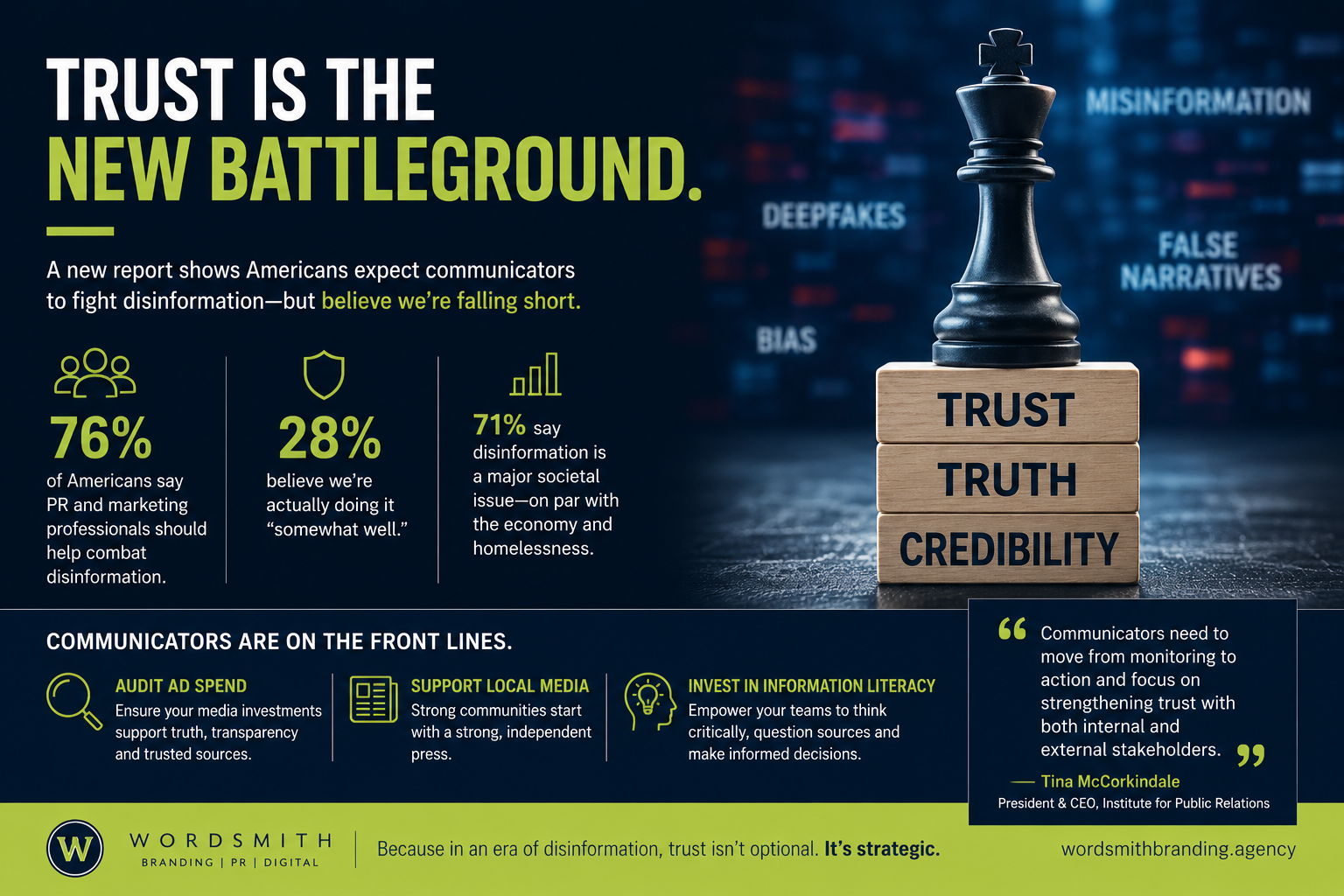
According to the Institute’s 2026 Disinformation in Society Report, 76% of Americans believe PR and marketing professionals should help combat disinformation.
Only 28% believe they are doing so effectively.
That gap matters.
Not just because of perception —
But because it reflects a broader shift in expectations around trust, credibility and leadership.
The findings are striking.
More than 70% of Americans now view disinformation as a major societal issue — on par with concerns like the economy and homelessness.
And while social platforms continue to receive much of the blame, the report points to something increasingly important for organizations:
The challenge is no longer just technological.
It is communicational.
That distinction matters.
Because it reframes the role of communications professionals from content creators and brand stewards to something more consequential:
Trust architects.
Organizations today are operating in an environment where audiences constantly evaluate credibility in real time.
In an era shaped by disinformation, trust is no longer a soft metric. It is strategic infrastructure.
Messages are scrutinized.
Sources are questioned.
Intent is interpreted.
And trust — once lost — is difficult to rebuild.
This is where many organizations fall short.
They continue to view communications primarily through the lens of promotion:
Visibility.
Engagement.
Reach.
But the environment has changed.
Today, communications is increasingly tied to organizational trust itself.
That means communicators are no longer responsible only for amplification.
They are responsible for clarity, consistency and credibility.
The Institute for Public Relations report offers several practical recommendations:
• Audit advertising and media spend
• Support credible journalism and local media
• Invest in information literacy internally
These are not merely tactical decisions.
They are trust decisions.
And they reflect a larger reality:
Organizations are now judged not only by what they communicate —
But by how responsibly they participate in the information environment itself.
That raises the stakes for communicators.
But it also elevates the profession.
The organizations that lead in this environment will not be the loudest.
They will be the clearest.
The most credible.
And the most disciplined in how they communicate.
Because in an era shaped by disinformation, trust is no longer a soft metric.
It is strategic infrastructure.

ABOUT THE AUTHOR