The Story Behind the Story, Part I: The Night That Changed Everything
In 1906, a Black newborn was abandoned in a Mississippi street. What happened next would shape a family, challenge the boundaries of its time, and leave a legacy that endured for generations.
Life started for Josie White on November 26, 1906, in the gutter of a dimly lit street in rural D’Lo, Mississippi, at the crossroads of the segregation era.
Born into uncertainty, she was abandoned by a young mother who did not know what to do with the child—or how to face the future that motherhood presented.
The rain came hard that night, rattling the tin rooftops of D’Lo like thrown gravel.
Those are the opening words of Josie: A True Story of Race, Rescue, and Resilience. They introduce a life that began under circumstances no child should have endured. But they also mark the beginning of a story about an extraordinary act of compassion, a family’s decision to love beyond the boundaries of its time, and a woman whose life would span nearly nine decades of Mississippi and American history.
This is where Josie’s story begins.
But it is not where her story ends.
A Child in the Darkness
To understand the significance of Josie’s story, we must first understand the world into which she was born.
Mississippi in 1906 was a place where race determined much of daily life. Jim Crow segregation shaped schools, public spaces, transportation, health care, and the opportunities available to Black citizens. The color line was not merely a social custom. It was embedded in the laws, institutions, and expectations of the era.
In that world, a Black infant abandoned in the street might easily have disappeared into a tragedy that no one remembered.
Josie’s story could have ended before it truly began.
But someone heard her cries.
W.D. and Nora Cook learned what was happening and responded. W.D. acted, and together he and Nora helped secure the care the newborn needed. What began as an urgent response to a child in danger would become a life-changing commitment.
Josie would become part of their family.
It was a remarkable choice in a society that insisted Black and white families remain separated by rigid racial boundaries. The Cooks’ decision did not erase the prejudices of their time, nor did it mean the road ahead would be easy. But it gave Josie something she desperately needed: the opportunity to live, grow, learn, and become her own person.
An entire lifetime opened because someone chose to act.
The Choice That Changed Everything
We often think of history as the story of presidents, laws, wars, and movements. Those events matter. But history is also shaped by decisions made in the dark, far from the public eye.
A person hears a cry.
A family faces a choice.
Someone decides that compassion matters more than convention.
The consequences may reach far beyond what anyone could have imagined at the time.
W.D. and Nora’s response to Josie was one of those moments. They could not have known everything her future would hold. They could not have predicted the decades of change she would witness, the relationships she would build, or the legacy that would grow from her life.
They knew there was a child who needed help.
And they helped her.
That is one of the reasons I wanted to tell this story. In an era defined by racial division, Josie’s life reveals the power—and the complexity—of a family who chose to act with humanity in circumstances that encouraged them to do otherwise.
The choice did not solve the larger problems of the South. It did not end segregation or remove the barriers Josie would encounter. But it changed one child’s future. And sometimes, that is where a much larger story begins.
More Than the Baby in the Gutter
When people first hear the premise of Josie, the image of the abandoned newborn tends to stay with them. It is an unforgettable beginning, and understandably so.
But I did not write this book simply to tell the story of a baby who was rescued.
I wrote it to tell the story of the woman she became.
Josie grew up within a family—my family—that gave her a place to belong. She learned, worked, worshiped, formed deep relationships, and navigated a world that was changing—often painfully and unevenly—around her. Her life carried her through the Jim Crow South, the Great Depression, World War II, the Civil Rights Movement, Hurricane Camille, and decades of personal and social change.
She was a daughter and sister, a teacher, a woman of faith, and a source of strength to the people around her. Her life was not defined by a single night, even though that night set everything in motion.
The rescue was the beginning.
The life that followed is the story.
And that distinction matters. Josie was never merely the infant at the center of an extraordinary family decision. She was a human being whose life had its own texture, relationships, struggles, joys, disappointments, and triumphs.
She deserves to be remembered for all of it.
The Story Behind My Story
For much of my life, Josie was not a historical figure or a character in a manuscript. She was family.
I knew her. My family knew her. Her story was woven into the lives and memories of people I loved. For years, I understood that there was something remarkable here—a story about race, rescue, family, faith, compassion, and resilience that deserved to be shared more widely.
But family memories alone could not tell the whole story.
To bring Josie’s life to the page, I had to go beyond what I remembered and what others could recount. I needed to research the historical setting, explore the realities of life in Mississippi, and confront the questions left behind by the passage of time. Historical fiction gave me a way to bring documented events to life while imagining the scenes, conversations, and private moments the historical record could not fully preserve.
That process required care. It also required a willingness to enter a painful chapter of American history without reducing the people who lived through it to simple heroes or villains.
The South of Josie’s lifetime was complicated. Its racial divisions were real and destructive. The people who challenged those divisions did not do so in a vacuum, and their choices did not make the injustice around them disappear.
Yet within that complicated history were acts of courage, compassion, and love that deserve to be remembered.
Josie’s life gave me a way to explore those truths through the experiences of one family and one remarkable woman.
Sometimes the most important story a writer can tell is the one closest to home.
Why This Story Matters Now
More than a century has passed since the night Josie was born. The world has changed in ways that would have been difficult for the people of D’Lo to imagine.
But the questions at the heart of her story remain relevant.
What do we owe one another when circumstances make compassion difficult?
How do we respond when the boundaries imposed by our culture conflict with our deepest sense of humanity?
What does it mean to build a family—not simply through biology, but through commitment, sacrifice, and love?
And how do we decide what a life will mean when the circumstances of its beginning seem to point toward an entirely different ending?
Josie’s story does not offer easy answers to every question. It offers something more valuable: a life through which we can explore them.
Her story reminds us that a person’s beginning does not have to determine the limits of their future. It reminds us that ordinary people can make extraordinary choices. And it reminds us that the legacy we leave is shaped not only by what happens to us, but by what we do with the lives we are given.
That is the deeper meaning of resilience.
It is not simply enduring hardship. It is continuing to live, love, serve and grow in the face of it.
The Journey Begins
This is the first installment in The Story Behind the Story, a series exploring the people, places, pivotal moments, and family relationships that shaped Josie: A True Story of Race, Rescue, and Resilience.
In the installments ahead, we will leave the dark street in D’Lo and follow Josie into the world that opened around her: her childhood in Forest, the family relationships that helped shape her, the lessons she encountered at Piney Woods School, reunions in Meridian, and the questions that eventually led her far beyond Mississippi.
Her story will take unexpected turns. There will be moments of belonging and painful rejection, faith and uncertainty, courage and heartbreak. Through it all, we will meet a woman whose life became much larger than the circumstances of her birth.
I invite you to take that journey with me.
Because Josie’s story is not simply a story about the past. It is a story about the choices that shape our lives, the people who help us become who we are, and the legacy that remains after we are gone.
Your story is not merely what happened to you. Your story is what you choose to do with what happened to you.
That is a belief I have carried through my work as a writer and communications strategist. It is also one of the truths I discovered in telling Josie’s story.
Her life began in a gutter on a rainy night in Mississippi.
What followed was a lifetime worth remembering.
Meet Josie
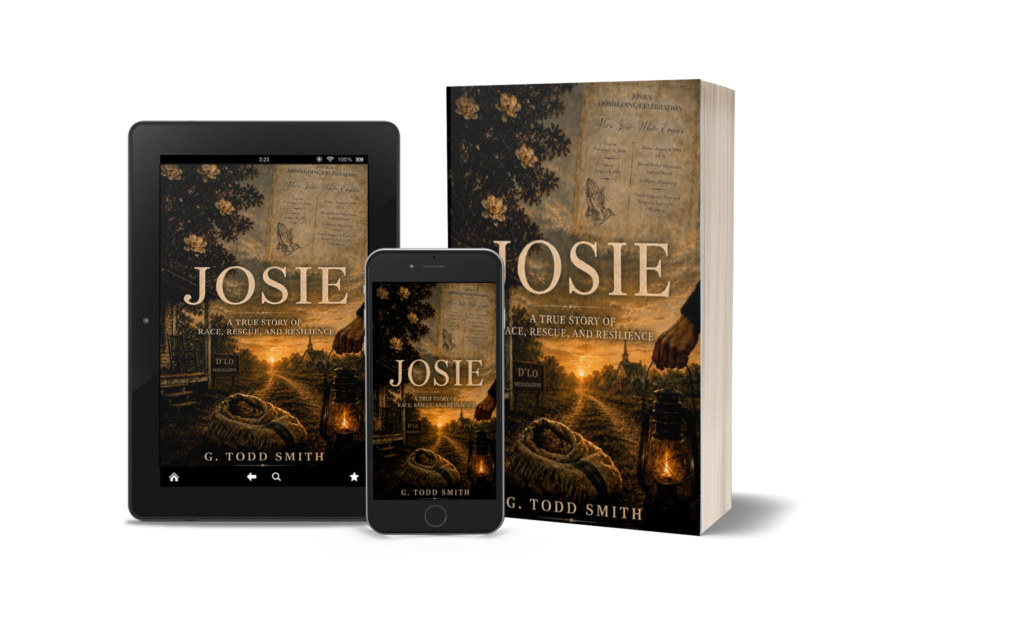
Josie: A True Story of Race, Rescue, and Resilience by G. Todd Smith is now available in eBook, hardcover and paperback.
Read the story. Remember the life. Carry the legacy.
Next in The Story Behind the Story: A Childhood Begins—how Josie grew up in Forest, Mississippi, surrounded by family, learning, and the relationships that helped shape her life.