The Devil Wears Prada 2 and the New Era of Experiential PR
For decades, marketing campaigns largely revolved around one goal:
Visibility.
Buy the ads.
Book the interviews.
Secure the media coverage.
Drive awareness.
But today’s communications environment looks very different. Explore why more visibility ≠ more impact.
Traditional media influence has fragmented.
Audience attention is scattered.
And consumers increasingly move fluidly between platforms, creators, experiences and communities.
That shift is forcing brands, studios and organizations to rethink something fundamental:
People no longer want to simply consume stories.
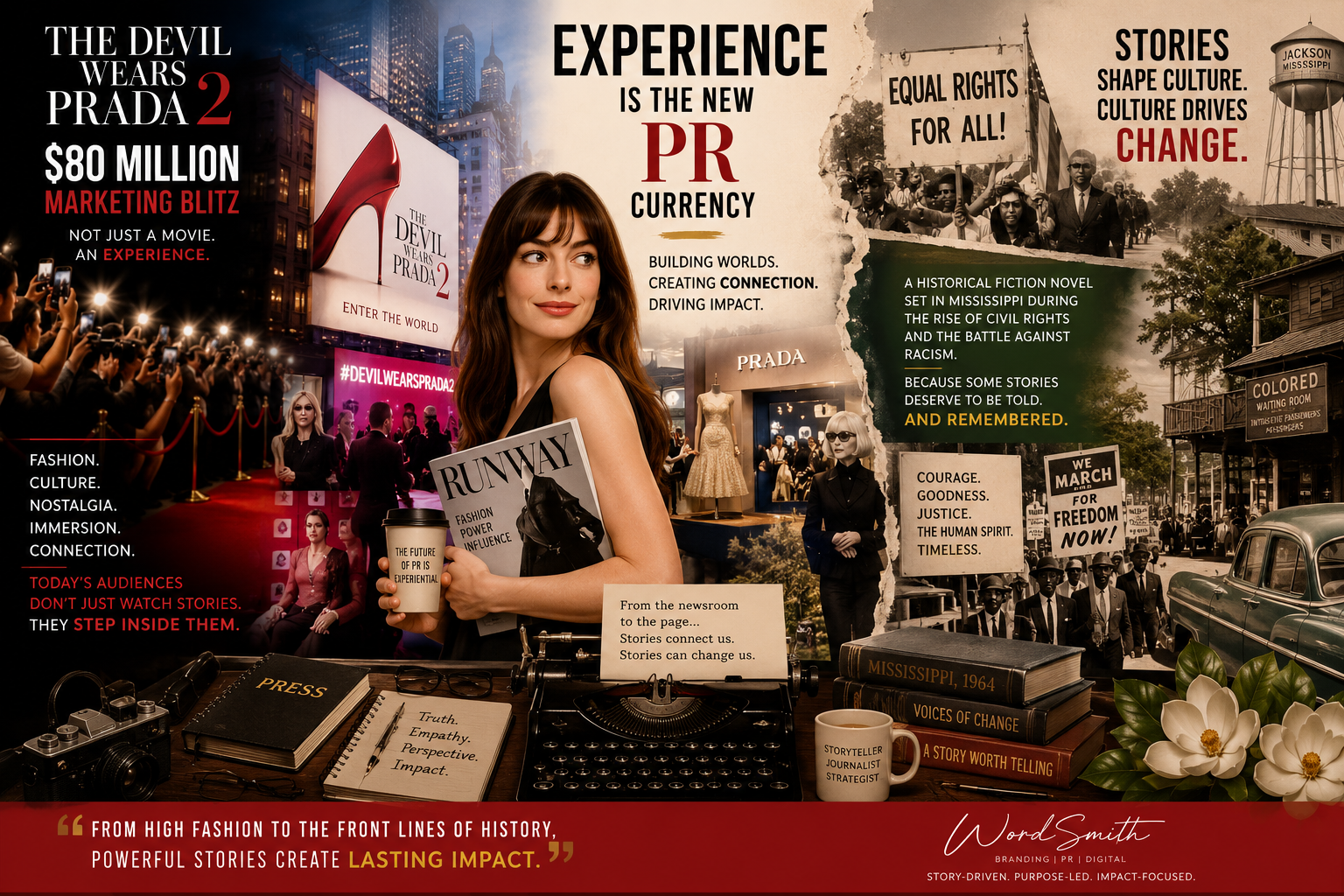
Disney’s reported $80 million marketing campaign surrounding The Devil Wears Prada 2 offers a compelling example of this evolution.
But the campaign wasn’t simply about advertising a movie.
They want to step inside them.
According to reports, Disney spent nearly as much promoting the sequel as it did producing the film itself.
It was about building an ecosystem audiences could emotionally enter and participate in.
Fashion moments.
Experiential activations.
Social media immersion.
Cultural nostalgia.
Narrative callbacks.
Influencer integration.
People no longer want to simply consume stories. They want to step inside them.
The campaign transformed promotion into participation.
And that distinction matters.
Because in today’s environment, experiential PR is becoming increasingly important precisely as traditional media influence continues to shrink.
Audiences are overloaded with information. Dive into the virtues of strong messaging and why most messaging fails.
What breaks through now is not merely exposure —
It is emotional connection and lived relevance.
That’s why experiential communications strategies continue to gain momentum across industries.
The most effective campaigns today do more than communicate messages.
They create environments.
They create emotional entry points.
They allow audiences to feel connected to a narrative larger than a single advertisement, interview or press release. Check out the WordSmith alignment model for more.
At its best, experiential PR turns audiences into participants.
That creates something traditional visibility alone often cannot:
Memory.
This shift extends far beyond entertainment.
Organizations across industries increasingly face the same challenge:
How do you create emotional resonance in a fragmented media ecosystem?
The answer often lies not in saying more—
But in creating experiences people remember and share.
As someone who spent years in journalism and strategic communications — and who recently signed a publishing deal for a historical fiction novel centered on goodness in Mississippi during the height of the civil rights era — I’ve thought deeply about the enduring power of narrative.
Stories matter because they help people emotionally process complex realities.
That remains true whether the platform is journalism, film, communications strategy or fiction writing.
And perhaps that is part of what makes The Devil Wears Prada 2 resonate beyond nostalgia.
Anne Hathaway’s return to Andy Sachs is not simply a sequel.
It is a continuation of a narrative audiences already emotionally inhabit.
That familiarity creates immediate connection.
The smartest communicators understand this instinctively.
People remember what they experience emotionally.
Not just what they see.
In many ways, the future of strategic communications may depend less on who generates the most content —
And more on who creates the most meaningful connection.
Because in today’s environment, attention is fleeting.
But experience is memorable.

ABOUT THE AUTHOR