The DNA of Strong Messaging & Bold Remarks
Strong messaging is often talked about in abstract terms.
Clear. Compelling. Authentic.
But what does it actually look like?
What does strong messaging sound like in a speech, a media interview, a brand narrative, or a moment of crisis?
The answer is surprisingly consistent.
Whether you study great leaders, effective communicators, or enduring brands, strong messaging tends to share five characteristics.
-
- It Is Clear Before It Is Clever
Strong messaging doesn’t try to impress first.
It tries to be understood.
The best communicators simplify without oversimplifying.
Think of some of the most enduring lines in public life:
“We choose to go to the moon…”
“I have a dream…”
“Ask not…”
None were complicated.
All were clear.
Strong messaging cuts through because it is precise. It’s the convergence of brand and communications!
Clarity is not the enemy of sophistication.
It is its foundation.
-
- It Is Built Around One Central Idea
Weak messaging often tries to say everything. Check out the why most messaging fails dispatch.
Strong messaging knows what matters most.
The best speeches, presentations, and campaigns usually orbit around one governing idea.
One message people can remember.
One idea they can repeat.
In communications, memorability often matters more than volume.
-
- It Uses Language People Can Feel
Facts inform.
Language moves.
Strong messaging doesn’t rely on jargon or abstraction.
It uses concrete language, contrast, rhythm, and imagery.
It gives people something to see.
Something to feel.
Something to carry forward.
That’s why the best communicators don’t just deliver information.
They shape meaning.
-
- It Holds Together Under Pressure
Strong messaging is not only effective in prepared moments.
It remains coherent in difficult ones.
Under questioning.
Under scrutiny.
Under crisis.
That is where message discipline matters.
The strongest communicators return to core themes again and again — not mechanically, but consistently.
That consistency builds trust.
-
- It Connects Message to Meaning
Strong messaging doesn’t just communicate activity.
It communicates significance.
Not just what happened —
But why it matters.
This is where many organizations fall short.
They announce.
They describe.
But they don’t interpret.
And interpretation is where influence begins.
If you want to understand what strong messaging looks like in practice, study moments where communication carried extraordinary weight.
Three Moments Stand Out
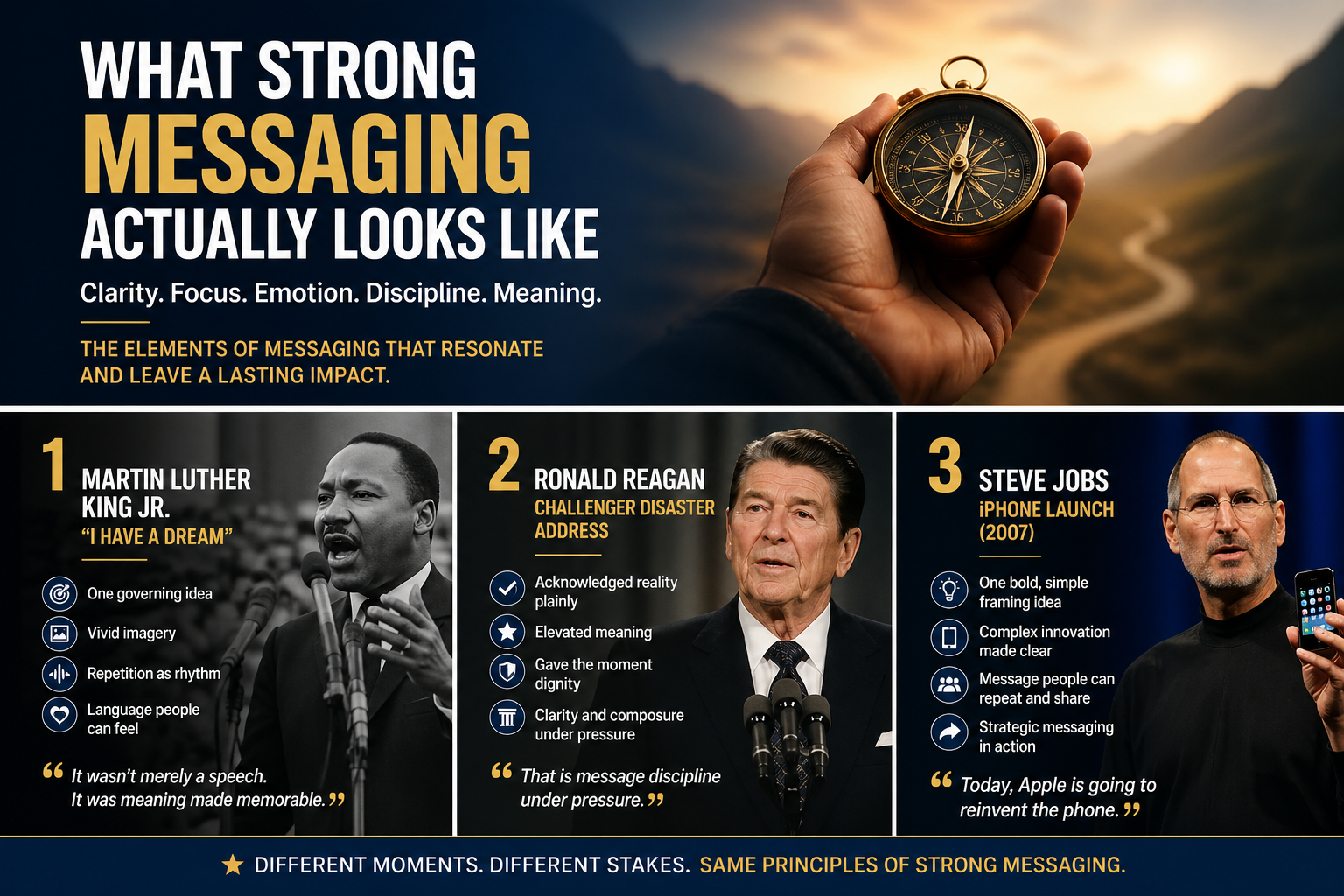
1. Martin Luther King Jr. — “I Have a Dream”
Its power wasn’t just in moral force.
It was in message architecture.
A single governing idea.
Vivid imagery.
Repetition used as rhythm.
Language people could feel.
It wasn’t merely a speech.
It was meaning made memorable.
2. Ronald Reagan — Challenger Disaster Address
In a moment of grief and national uncertainty, Reagan did what strong communicators do in crisis:
He acknowledged reality plainly.
He elevated meaning.
And he gave the moment dignity.
He didn’t rely on volume or rhetoric.
He relied on clarity and composure.
That is message discipline under pressure.
3. Steve Jobs — iPhone Launch (2007)
Jobs understood a principle many communicators forget:
People remember ideas framed simply.
“Today, Apple is going to reinvent the phone.”
One sentence.
Clear. Bold. Repeatable.
Complex innovation was translated into one unforgettable idea.
That is strategic messaging.
Different moments.
Different stakes.
Same underlying principles:
Clarity.
Focus.
Emotion.
Discipline.
Meaning.
So what does strong messaging actually look like?
It looks like clarity.
It sounds like conviction.
It carries one core idea.
It uses language people can feel.
And it connects information to meaning. Like striking KitKat PR gold.
The lesson is not that every organization should sound like a historic speech or product launch.
It’s that strong messaging leaves patterns.
And those patterns can be studied — and built.
At WordSmith, we often say:
Strong messaging isn’t measured by how much is said.
It’s measured by what people remember. How you make them feel.
And ultimately —
What they believe!

ABOUT THE AUTHOR